There are few better places in Europe to own a boat than the Balearic Islands.
Mallorca, Menorca, Ibiza and Formentera offer hundreds of miles of coastline, warm water, reliable summer weather and an almost ridiculous number of coves where you can drop anchor for lunch and wonder why you ever bothered booking a hotel.
For anyone planning their first season cruising the Balearics, though, the islands can also be deceptive. Distances look short on the chart, marinas become busy and expensive in high summer, anchorages that are idyllic in the morning can become uncomfortable by evening, and the rules around anchoring over Posidonia seagrass are taken increasingly seriously.
Approach it properly and the Balearics are one of the easiest and most rewarding cruising grounds in the Mediterranean.
Mallorca: The Best Place to Start
If you're new to boating in the Balearic Islands, Mallorca is probably the easiest introduction.
It's the largest island, has the biggest choice of marinas and marine services, and offers enough variety that you could happily spend an entire season exploring it without going anywhere else.
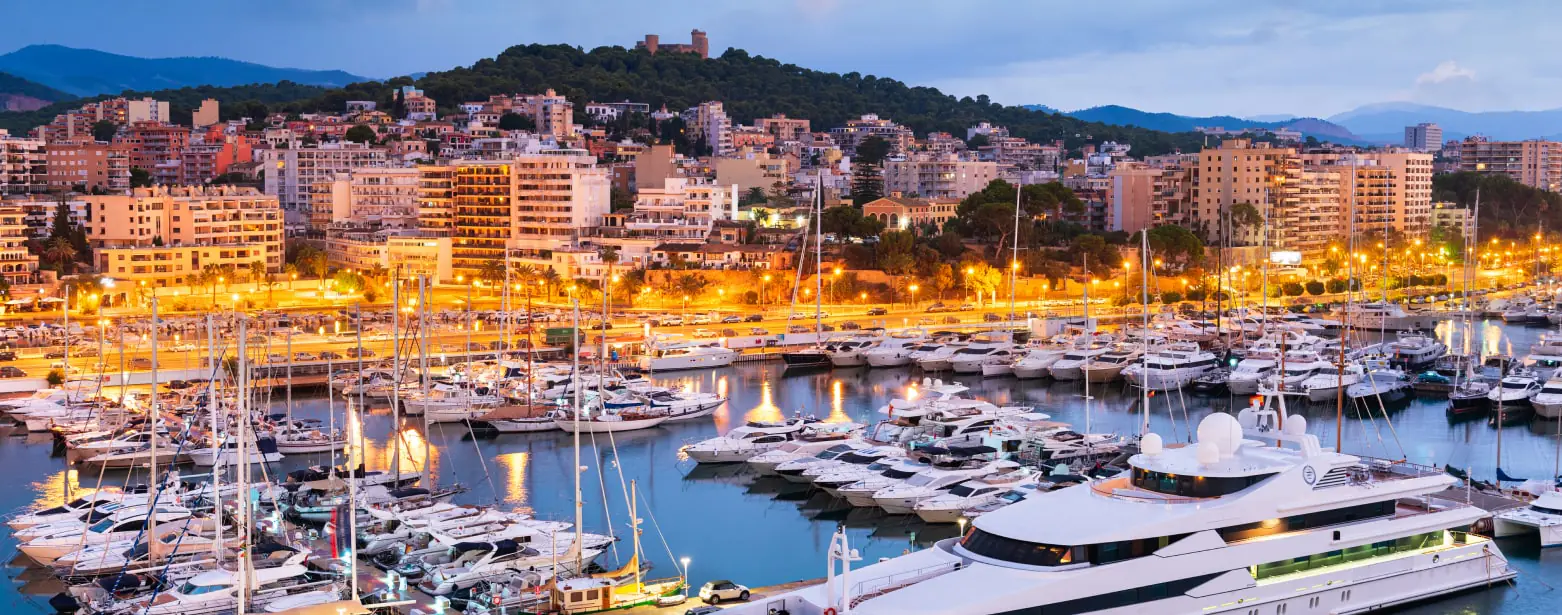
Palma is the obvious centre of gravity, with excellent marine infrastructure and easy access to the southwest coast. From there, popular cruising areas include Portals Vells, Santa Ponça, Andratx and the dramatic western coastline towards Sóller.
The north and east feel different again. Pollensa and Alcúdia provide large, relatively sheltered bays, while the southeast around Cala d'Or, Porto Petro and Mondragó is classic Mediterranean cruising territory: limestone coves, pine trees and impossibly clear water.
Mallorca's scale is actually one of its strengths. If the forecast makes a longer passage unattractive, there is nearly always somewhere worthwhile relatively close by.
Ibiza and Formentera: Better from the Water
Ibiza makes far more sense from a boat than it does from a hire car.
Away from the nightlife, much of the coastline is surprisingly rugged and quiet, with anchorages including Cala Bassa, Cala Conta and the north of the island giving an entirely different perspective on Ibiza.
Then there is Formentera.
The crossing between Ibiza and Formentera is short enough to make them natural cruising partners, and the water around Formentera is some of the clearest in the western Mediterranean.
Ses Illetes is the obvious attraction, although it can become extremely busy in July and August. Arriving early or visiting outside peak season makes an enormous difference.
The official Balearic tourism authority describes Ibiza and Formentera as relatively sheltered compared with Mallorca and Menorca because of their position closer to mainland Spain, although conditions can of course still change quickly.
If your idea of cruising involves swimming, lunch ashore and moving between beautiful anchorages rather than covering huge distances, Ibiza and Formentera are difficult to beat.
Menorca: The Island Worth Making the Passage For
Menorca feels noticeably less developed than Mallorca or Ibiza.
For many boat owners, that's precisely the attraction.
The south coast contains some of the Balearics' most beautiful calas, while Mahón provides one of the Mediterranean's great natural harbours and an excellent place to provision, refuel or wait out poor weather.
Ciutadella on the western side is equally worthwhile, particularly if you're approaching from Mallorca.
Menorca is, however, more exposed. The island is affected by weather coming down from the Gulf of Lion, and the Tramontana can turn what looked like a straightforward itinerary into several days spent somewhere you hadn't originally planned to stay.
That isn't a reason to avoid Menorca. It's simply a reason not to plan a first Balearic cruising season like a package holiday.
On a boat, the forecast writes the itinerary.
The Balearics Are Made for Anchoring — With One Important Catch
One of the great pleasures of cruising Mallorca, Ibiza, Menorca and Formentera by boat is that you don't need to spend every night in a marina.
Many of the best experiences are at anchor.
But you need to understand Posidonia.
The underwater meadows of Posidonia oceanica are a protected part of the Balearic marine environment, and anchoring on them is prohibited. The rule matters not only where the anchor itself lands: your chain and other ground tackle shouldn't damage the seagrass either.
The Balearic Government has significantly increased enforcement. For the 2026 season it deployed 20 Posidonia-surveillance vessels across the four main islands, specifically to prevent boats anchoring on protected meadows.
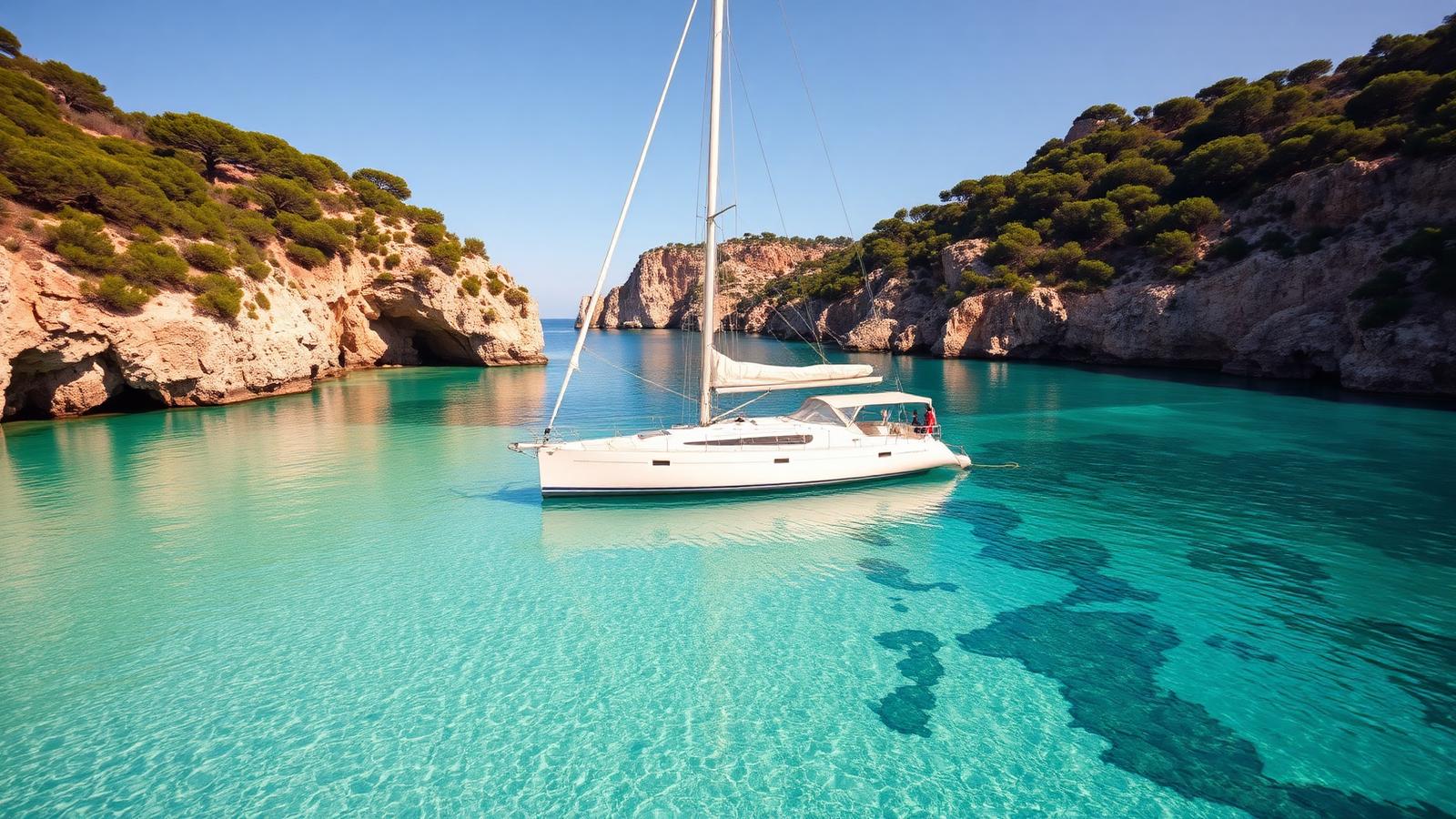
That means learning to identify sandy patches before dropping the hook. In clear Balearic water the distinction is usually obvious: pale turquoise generally indicates sand, while darker areas often indicate vegetation.
If you're uncertain, use an authorised mooring buoy or move somewhere else.
It is one of those situations where being approximately right isn't good enough.
Don't Try to Book Every Night in Advance
For a first season, there's a temptation to organise everything: Palma Monday, Andratx Tuesday, Sóller Wednesday and so on.
That can become frustrating surprisingly quickly.
Weather changes. You discover an anchorage you love. Somebody wants to stay another night. Or a marina you were relying on is full.
A better approach is to have a general direction of travel with several alternatives.
In July and August, however, popular marinas can become extremely busy, so booking ahead makes sense when you absolutely need a berth.
There are around 50 marinas and yacht clubs across the Balearic Islands, giving cruising boats plenty of options, but demand around the most desirable locations is substantial in peak season.
May, June, September and early October are arguably even better months for boat owners. The water is warm enough for swimming, restaurants and marinas are open, and the cruising grounds feel dramatically less crowded.
Cabrera: Make the Effort
If you're cruising southern Mallorca, the Cabrera Archipelago National Park deserves to be near the top of your list.
Cabrera lies south of Mallorca and feels considerably more remote than the distance suggests. The natural harbour provides a spectacular overnight stop surrounded by protected landscape rather than hotels and apartment blocks.
But you cannot simply arrive and drop anchor wherever you like.
Navigation within Cabrera National Park requires authorisation, while overnight mooring must also be booked. Current rules allow a maximum of 50 overnight mooring permits per day in Puerto de Cabrera. During July and August, authorisations are generally limited to two consecutive nights, compared with up to seven nights during the remainder of the year.
It's therefore one part of a Balearic itinerary worth organising properly in advance.
The reward is one of the most memorable nights you can spend aboard a boat anywhere in Spain.
Weather Matters More Than Distance
The distances between the islands are entirely manageable for a capable cruising boat, but don't confuse short passages with guaranteed easy passages.
Mallorca to Ibiza, Mallorca to Menorca and the run across to Formentera all place you in open Mediterranean water.
Summer mornings can be beautifully calm before local winds strengthen during the afternoon. Strong northerly conditions can affect Menorca and northern Mallorca, while anchorages that are completely protected from one direction may be exposed from another.
This is probably the most important habit to develop during a first season:
Check the weather before deciding where you're going, not after deciding where you're going.
Don't become attached to an itinerary simply because you've already told everyone that's where you're heading.
Some of the best cruising days are the ones where you change plans at breakfast.
How Much Fuel and Water Do You Need?
For motorboat owners, fuel naturally becomes one of the biggest considerations when moving between islands.
There is good availability around the major ports, but it is worth refuelling before longer passages rather than relying on a particular fuel berth at the end of the day.
The same applies to freshwater.
If you're spending several days moving between anchorages, you'll use much more than you expect once showers, washing-up and children repeatedly rinsing themselves after swimming are involved.
A yacht with relatively modest tankage can simply refill frequently. Larger motor yachts often have enough capacity that it becomes less of a concern.
Either way, don't spend your first week discovering exactly how inaccurate the freshwater gauge is.
The Dinghy Becomes Your Car
If you intend to anchor regularly, a decent tender transforms the experience.
Suddenly a night at anchor doesn't mean being trapped aboard.
You can go ashore for breakfast, pick up food, visit a beach or have dinner in a waterfront restaurant without moving the main boat.
For Mediterranean cruising, an inflatable tender with a small outboard is arguably one of the most useful pieces of equipment aboard.
The bathing platform becomes the front door. The tender becomes the family car.
Just remember that an idyllic-looking beach may not always provide an obvious or permitted landing point, particularly in protected areas.
Don't Ignore the Basics
The Balearics can feel remarkably forgiving in summer. Warm weather, clear water and countless other boats around you create a sense that little can go wrong.
That shouldn't make you casual.
Make sure everyone aboard understands lifejackets, kill cords where applicable, VHF use and what to do if the skipper becomes incapacitated.
Carry proper ground tackle rather than the smallest anchor the boatbuilder thought it could get away with. Know how much chain you have deployed and allow for the fact that an empty cala at lunchtime may look very different once another 20 boats arrive.
Most importantly, be prepared to leave.
If an anchorage becomes uncomfortable at midnight, the fact that you have a restaurant booked there tomorrow isn't a reason to remain in it.
Which Island Is Best for a First Balearic Cruising Season?
If we had to choose just one, it would be Mallorca.
It provides the easiest combination of anchorages, marinas, repairs, provisioning and variety.
But the real attraction of owning or chartering a boat in the Balearics is that you don't have to choose.
A couple of weeks gives you time to combine Mallorca with Ibiza and Formentera, or Mallorca with Menorca. A full season lets you experience all four slowly enough that you stop treating them as destinations and start developing favourite anchorages, restaurants and marinas.
And that's when the Balearics become really addictive.
The first time you arrive in Cala d'Or or Port de Sóller is memorable.
The fifth time, when you already know where you're going to anchor, which restaurant you'll take the tender to and where the morning sun will hit the cockpit, is arguably even better.
The Verdict
For a first season cruising the Mediterranean, the Balearic Islands are difficult to beat.
They're accessible from mainland Spain, packed with good marine infrastructure and varied enough to suit everything from small sailing yachts to large motor cruisers. You can spend one night plugged into shore power in a busy marina and the next floating in turquoise water beneath an undeveloped cliff.
The trick is not to overcomplicate it.
Watch the weather, respect the Posidonia rules, book the places that genuinely require booking and leave enough flexibility to change your plans.
Because the best thing about cruising the Balearics isn't ticking Mallorca, Menorca, Ibiza and Formentera off a list.
It's discovering somewhere beautiful at four in the afternoon and deciding you're not going anywhere else that day.