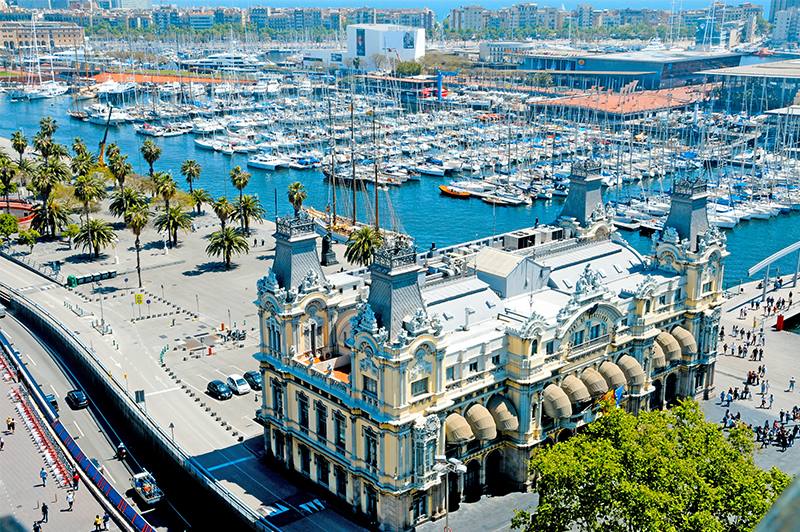
There are plenty of marinas that advertise themselves as being in Barcelona. Marina Port Vell actually is Barcelona.
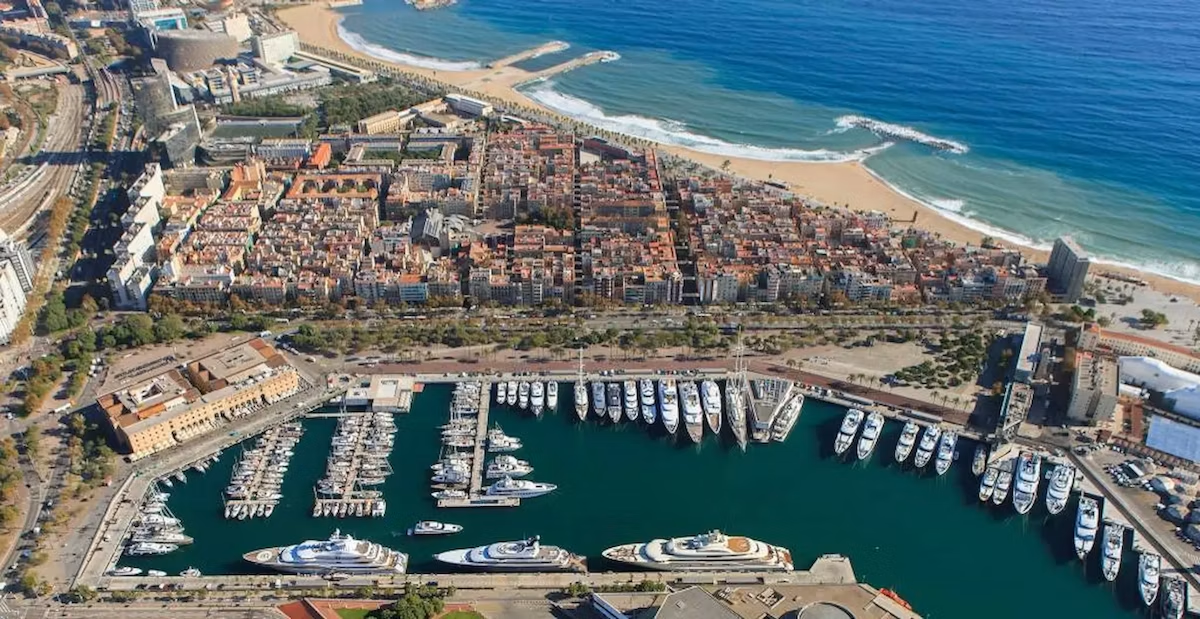
Set directly on the city's historic waterfront, with Barceloneta on one side and the Gothic Quarter just beyond the harbour on the other, it's difficult to think of many Mediterranean marinas with a better city-centre location. You can step off the yacht, walk to dinner and be among some of Barcelona's busiest streets within minutes.
That makes Port Vell instantly appealing, but there is an important distinction to make before going any further: this isn't really a conventional marina anymore.
Marina Port Vell has evolved into a specialist Barcelona superyacht marina, with just 73 berths but the ability to accommodate yachts approaching 190 metres in length. For ordinary cruising-yacht owners, much of what makes it exceptional is probably unnecessary. For the market it is designed to serve, however, Port Vell is one of the most impressive yacht bases in the western Mediterranean.
Barcelona at the End of the Pontoon
The location is Port Vell's trump card.
Most Mediterranean marinas involve some degree of compromise. A beautiful remote harbour might offer wonderful cruising but poor flights and limited services. A major commercial port might have excellent infrastructure but little reason to spend time there once you've left the boat.
Barcelona gives you both.
The marina sits on Moll de la Barceloneta, within easy walking distance of restaurants, bars, shopping and the old city. Barceloneta beach is nearby, while La Rambla, the Gothic Quarter and much of central Barcelona are easily accessible.
For an owner flying in for a long weekend, that's enormously convenient. Barcelona-El Prat Airport offers extensive international connections and the city's transport network means you don't necessarily need to arrange cars every time somebody arrives or leaves.
It also gives Port Vell something many seasonal Mediterranean marinas lack: life in winter.
Barcelona doesn't shut down when summer ends. Restaurants remain busy, flights continue and the city remains somewhere owners and crew actually want to spend time.
For a yacht looking for a year-round Mediterranean home rather than simply a July berth, that matters.
This Is a Serious Superyacht Marina
The transformation of Port Vell becomes obvious once you look at what the marina can actually accommodate.
There are only 73 berths, but yachts of up to around 190 metres can be handled, with draughts of up to 10 metres and both stern-to and alongside configurations available.
The infrastructure reflects those dimensions.
Shore power is available at levels far beyond anything a normal cruising yacht would require, while large vessels can be fuelled directly at the berth. High-capacity water, communications, security and technical services are all designed around professionally crewed yachts rather than weekend sailing boats.
Security is similarly serious, with controlled access, CCTV and round-the-clock monitoring within an ISPS-compliant environment.
The Docks in Numbers
The marina's own berth information page breaks the basin down dock by dock. We have described each one by its position, as the marina does, rather than by name.
| Dock (position in the marina) | Largest yacht | Berthing | Shore power |
|---|---|---|---|
| Southern edge, the main superyacht line (400m long) | 190m | Alongside with ground lines | Up to 1,600A, 400V, 50Hz |
| Northern promenade dock beside the main entrance (400m long) | 80m | Stern-to with ground lines | Up to 630A |
| South-eastern dock near the Escar entrance | 80m | Stern-to with ground lines | Up to 800A |
| Eastern dock beside The Gallery and Tower buildings | 80m | Stern-to with ground lines | Up to 630A |
| Central pontoon beside the fuel station | 70m | Stern-to | Not stated |
| North-western dock under the old city wall | 50m | Stern-to with ground lines | Up to 400A |
| Compact north-western dock beside the History Museum | 40m | Stern-to | Up to 250A |
Fuel comes two ways. There is a 24-hour fuel station on the central pontoon selling diesel and unleaded, and a 500m pipeline network that delivers to the berth at 400 to 450 litres a minute. The marina also lists 164 parking spaces for clients around the Barceloneta, España and Reloj docks, and storage beside the berths, with 20ft and 40ft containers for bigger needs.
The figure that matters most for a smaller boat is at the bottom of that table. The smallest dock is built for yachts up to 40 metres. Nothing on the marina's site describes berths for a 12-metre cruising boat.
None of this is particularly romantic.
It is, however, exactly what you want when the boat tied to the pontoon is worth tens or hundreds of millions of euros.
Port Vell feels less like an enlarged yacht club and more like a luxury marine operations centre that happens to sit in one of Europe's most interesting cities.
Life Ashore Is Exceptional
For owners and guests, Barcelona provides more than enough entertainment without the marina needing to manufacture it.
The immediate waterfront has plenty of restaurants and bars, but the real advantage is simply being able to walk into the city.
Spend the morning aboard and you can be eating seafood in Barceloneta at lunchtime, shopping around Passeig de Gràcia in the afternoon and having dinner in the Gothic Quarter that evening.
That's a very different proposition from a remote marina where every excursion involves organising a taxi.
There are also dedicated facilities within Marina Port Vell itself, including concierge services, fitness facilities, meeting areas and hospitality spaces. Professionally crewed yachts are well catered for, with facilities intended as much for those working aboard as for the owners arriving for a weekend.
That distinction is important. A superyacht marina also has to work as a workplace for crew and contractors, as well as being a luxury marina.
Port Vell understands that particularly well.
What Is It Like as a Cruising Base?
This is where Barcelona loses ground to somewhere like Mallorca.
Port Vell provides excellent access to the Catalan coast. Head northeast and the cruising becomes increasingly attractive towards the Costa Brava, with places such as Palamós, Begur and Cadaqués making natural destinations.
Head south and there is a long stretch of Catalan and Valencian coastline to explore.
But there isn't the density of spectacular anchorages immediately outside the marina that you'd find in the Balearics.
A boat based in Palma can leave the harbour and be anchored beneath cliffs in clear turquoise water surprisingly quickly. Our guide to cruising the Balearics covers that side of the comparison. From Barcelona, the most rewarding cruising generally involves travelling further.
For a large motor yacht, that's hardly a problem. Mallorca is a perfectly realistic passage rather than an expedition. When you get there, the Mediterranean anchoring guide covers the rules and holding.
For somebody choosing a home berth primarily because they want beautiful anchorages on the doorstep, though, Barcelona wouldn't be our first choice.
Port Vell's advantage isn't the water immediately outside.
It's everything immediately ashore.
And Then There Is the Costa Brava
That isn't to say Barcelona provides poor cruising.
Far from it.
Heading north along the Catalan coast eventually brings you into some beautiful territory. The Costa Brava becomes increasingly rugged, with rocky bays, small harbour towns and anchorages that feel a long way removed from Barcelona.
For an owner with enough time, this makes Port Vell an interesting starting point for cruising towards southern France and eventually the wider western Mediterranean.
Barcelona is also extremely well positioned for boats moving between the Balearics, France and mainland Spain.
That makes it arguably more appealing as a strategic base for a yacht that travels regularly than as somewhere for a small boat that rarely ventures more than 20 miles from home.
How Expensive Is Marina Port Vell?
Port Vell doesn't operate like a normal marina with a neat annual tariff saying a 12-metre boat costs one figure and a 15-metre boat another.
Berthing is quoted according to the yacht, its dimensions, duration of stay and requirements. The marina's berth rental page asks for the yacht's details and arrival date through an enquiry form, and we could not find a published price list anywhere on its site in October 2026. Berths are offered for short stays, rental or long-term lease.
That makes sense.
When one berth might be accommodating a 40-metre yacht and another something well over 100 metres, a simple price-per-metre tariff doesn't tell you very much.
What you can safely assume is that Marina Port Vell isn't a budget Barcelona marina.
So the useful thing we can do is show what the published marinas around Barcelona charge. That gives a 12-metre or 24-metre owner a real number to compare, and it shows where Port Vell stops being an option and becomes the only option.
What the Other Barcelona Marinas Charge
We read the 2026 tariffs for three marinas that publish them: Port Olímpic, a short walk up the beach from Port Vell, Marina Badalona to the north east, and Port Masnou further up the coast. The three do not price the same way, so read the notes under each table before comparing.
- Port Olímpic charges long-term berths by the square metre of the berth (length times beam) per month, plus a community services fee and a monthly water and electricity charge. Its prices are shown without VAT.
- Marina Badalona gives a flat price per berth size, and its 2026 tariff (updated February 2026) says prices include IVA.
- Port Masnou gives a flat monthly price per berth size and a daily price per square metre. Its rate page does not say whether the monthly figures include IVA, and it still carries a note about the 2024 America's Cup, so ask the office to confirm the prices are current.
Long-Term and Monthly Berths
| Marina | Berth size used | Monthly price | Basis |
|---|---|---|---|
| Port Olímpic | 12 x 4.5m (54m²) | €667.46 | €9.49/m² plus €2.50/m² community fee plus €20 water and power, ex VAT |
| Port Olímpic | 25 x 6m (150m²) | €1,937.00 | €10.20/m² plus €2.50/m² plus €32 water and power, ex VAT |
| Marina Badalona | 12 x 4.5m | €625 | Inc IVA, power and water extra |
| Marina Badalona | 25 x 7m | €1,625 | Inc IVA, power and water extra |
| Port Masnou | 12 x 4.5m | €474.75 | IVA basis not stated |
| Port Masnou | 24 x 5 to 6.6m | €1,524.48 | IVA basis not stated |
Adding 21% VAT to the Port Olímpic figures gives €807.63 a month for the 12m berth and €2,343.77 for the 25m berth. The Port Olímpic water and power charge covers a set allowance (up to 70kWh and 2m³ of water a month on the €20 band, up to 120kWh and 3m³ on the €32 band), with extra electricity at €0.18 per kWh and water at €6.00 per m³.
Port Olímpic also takes 3% off the assignment fee for a contract of a year or more and 7% for five years. Long-term berths there run from two months to five years for private owners.
Marina Badalona publishes annual and six-month prices too. A 12 x 4.5m berth is €6,750 a year or €3,565 for six months, and a 25 x 7m berth is €17,550 a year or €9,265 for six months, all including IVA. The same tariff lists a separate maintenance charge of €3.3507 per square metre per month. The document does not make clear to us which berth holders pay it, so check before you budget.
For comparison, twelve months at Port Olímpic on the monthly figures above comes to €8,009.52 ex VAT for the 12m berth and €23,244 ex VAT for the 25m berth, before the one-year discount.
Visitor Berths by the Day
| Marina | 12m boat | 24 to 25m boat | Notes |
|---|---|---|---|
| Port Olímpic, high season (April to October) | €70.04 | €192.20 | 12 x 4.5m and 25 x 6m berths, ex VAT |
| Port Olímpic, low season (November to March) | €59.24 | €162.20 | Same berths, ex VAT |
| Marina Badalona | €65 | €215 | 12 x 4.5m and 25 x 7m, inc IVA, power and water included up to 25m |
| Port Masnou | €54 | €144 | €1 per m² per day, worked on 12 x 4.5m and 24 x 6m |
With VAT, the Port Olímpic day rates become €84.75 and €232.56 in high season, and €71.68 and €196.26 in low season. At Port Masnou, water and electricity are included for boats under 15m, cost €6.70 a day from 15 to 20m, and are metered above 20m.
What Happens at 40 Metres
This is where the comparison ends. Port Olímpic's largest berth band is 35 metres, Marina Badalona's tariff stops at 30 metres and Port Masnou's monthly list stops at 24 metres. None of the three published tariffs we read has a 40-metre berth.
A 40-metre yacht in central Barcelona is therefore in Port Vell's market more or less by default, and the price will be whatever the marina quotes. That is also the size of its smallest dock.
We also looked for published rates at Port Fòrum and Port Ginesta. We could not read a tariff for either in October 2026 (Port Ginesta's site returned a bot check to us), so they are left out of the tables rather than guessed at.
Taxes on Top
IVA. Spain's general rate of VAT is 21%, according to the Agencia Tributaria. Check whether any quote you are given includes it, because Barcelona marinas publish both ways. Port Olímpic quotes without it and Marina Badalona with it.
Port charges. Port Vell sits inside the Port de Barcelona, and the port authority lists a tax on recreational boats (the "tasa a las embarcaciones deportivas") among its official charges. We could not read the amount on its site, so ask the marina whether its quote already includes it.
Tourist tax. Catalonia's tourist tax (the impost sobre les estades en establiments turístics) applies to stays in hotels, holiday lets and other tourist accommodation, and to cruise vessels. The law defines a cruise vessel as one carrying passengers purely for pleasure with more than two nights on board. In Barcelona from 1 April 2026 the cruise rate is €4 per person for a call of more than 12 hours and €6 for 12 hours or less, plus a city surcharge of €5, according to the Agència Tributària de Catalunya. The law does not mention private yachts by name. A privately used yacht does not look like a taxable stay on our reading, but a charter yacht with guests sleeping aboard is less clear, so a charter operator should check with the ATC.
The Atmosphere Won't Suit Everyone
There is a slightly strange paradox to Port Vell.
It's in the heart of one of Europe's most characterful cities, yet the marina itself can feel quite controlled and corporate.
That's almost inevitable.
A harbour full of enormous professionally crewed yachts requires a different environment from a marina filled with 35-foot sailing boats whose owners meet in the bar after racing on Wednesday evening.
If what you enjoy most about marina life is chatting to neighbouring owners while somebody tries to repair an outboard on the pontoon, Port Vell probably isn't going to feel like home.
Likewise, anyone seeking tranquility should remember that the marina sits in central Barcelona. Once you're outside its secure environment, you're surrounded by one of Spain's busiest tourist destinations.
For others, that's exactly why they'd choose it.
Few places let you combine living aboard a yacht with city life quite so effectively.
Who Port Vell Is Worth It For
That depends almost entirely on the boat.
For a conventional 10- or 12-metre family cruiser, Port Vell is difficult to recommend simply because you'd be paying for infrastructure you don't need, and its docks are built for yachts of 40 metres and up anyway. The tables above show that a 12-metre berth a short walk away at Port Olímpic costs around €670 a month before VAT, and less again at Badalona or Masnou. Our guide to berthing costs in the UK and Spain puts those figures against typical UK prices.
Move into the superyacht market and the argument changes completely.
Port Vell offers deep water, enormous berths, serious shore power, high security, professional services, direct fuelling and one of the best-connected locations in the Mediterranean.
Then add Barcelona.
Owners will fly in even when the yacht isn't leaving the berth, and crew get a more interesting long-term base than most isolated ports. Captains also benefit, because the technical facilities and location make running a large yacht easier.
The Verdict
Marina Port Vell is aimed at large yachts, and as one of the superyacht marinas in the Mediterranean it is very good. For a typical family cruiser there are better-value berths nearby.
The location is exceptional, the infrastructure is serious and Barcelona gives the marina year-round appeal that many Mediterranean destinations simply can't match.
Mallorca provides better cruising on the doorstep. Smaller Spanish marinas provide substantially cheaper berthing. Traditional yacht clubs offer more community.
But very few places allow you to berth a 70-metre yacht, walk into one of Europe's great cities for dinner and fly almost anywhere in Europe the following morning.
For the right yacht and the right owner, that's exactly what makes Marina Port Vell special.
Jack & Anchor rating: 9/10
Exploring marinas in Spain?
The Jack & Anchor Marina Directory lets you compare marinas across Barcelona, the Balearics and the wider Spanish coast, including facilities, local cruising information and marine services.
If you're looking for the yacht to put in that berth, browse Boats for Sale or use BoatCheck to investigate a used boat before committing to the purchase.
Sources
All pages read in October 2026.
- Marina Port Vell, berth information
- Marina Port Vell, why Marina Port Vell
- Marina Port Vell, rent a superyacht berth
- Port Olímpic, mooring and services rates 2026
- Marina Badalona, tarifes 2026
- Port Masnou, alquiler de amarre
- Port de Barcelona, official port charges
- Agencia Tributaria, IVA rates
- Agència Tributària de Catalunya, tourist tax rates
- Generalitat de Catalunya, consolidated tourist tax law (IEET)