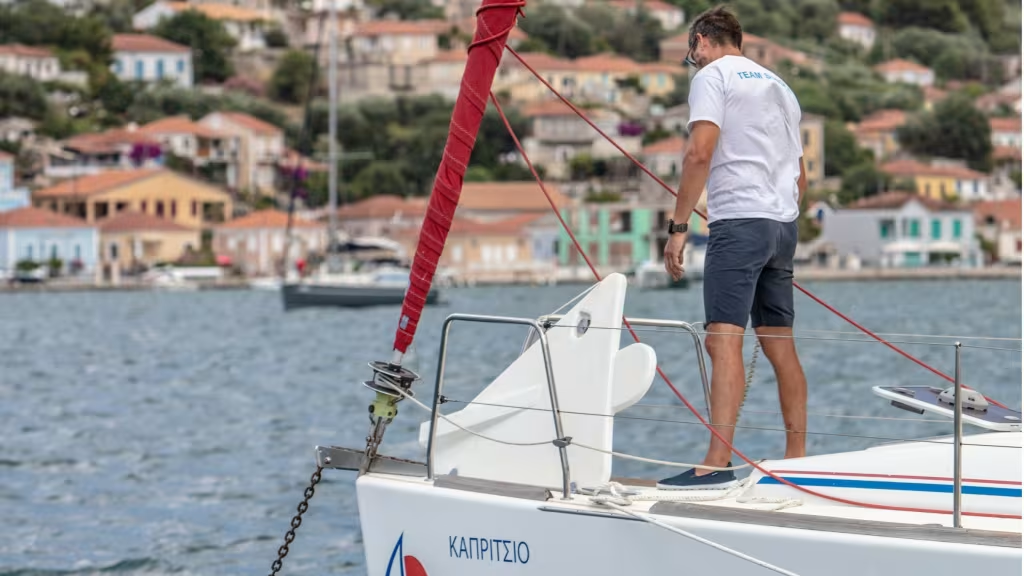
Anchoring in the Mediterranean looks deceptively easy.
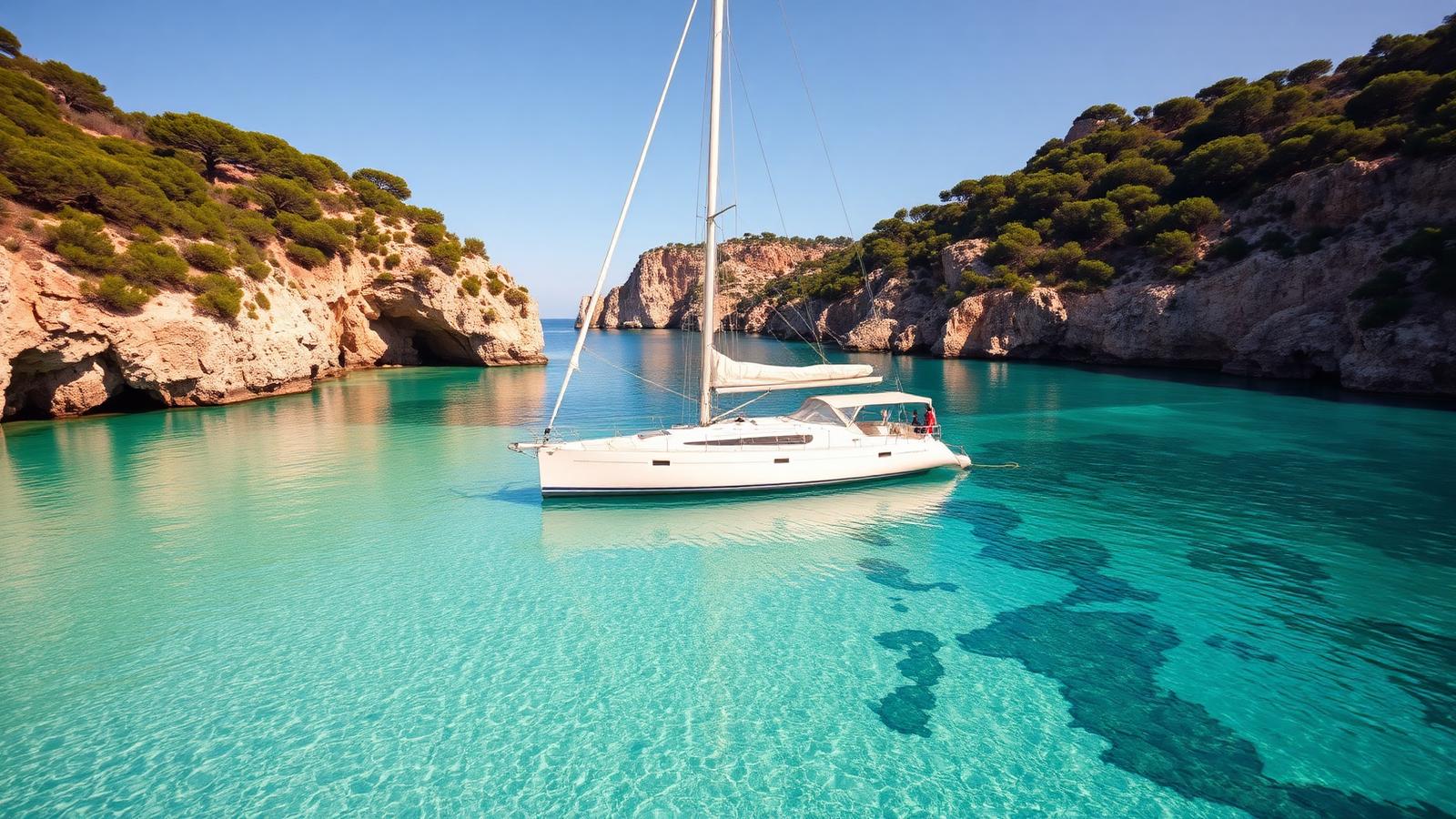
There is often little tide, the water is beautifully clear and many of the best anchorages are sheltered coves where you can see the bottom from the cockpit. Compared with dropping the hook in a murky British estuary with several metres of tidal range, it can feel almost effortless.
Then the afternoon sea breeze arrives, the anchorage fills with another 30 boats and someone discovers that the anchor was never properly set in the first place.
Good Mediterranean anchoring is about considerably more than dropping an anchor and switching off the engine. You need the right ground tackle, enough scope, an understanding of the seabed and — increasingly importantly — an awareness of protected Posidonia seagrass.
Get those things right and anchoring becomes one of the great pleasures of Mediterranean boating.
The Anchor Matters More Than Almost Anything Else
If there is one piece of equipment aboard where we'd rather have too much than too little, it's the anchor.
Modern designs such as Rocna, Spade, Mantus and Ultra have become popular because they generally set quickly and develop excellent holding power. Older CQR and Bruce-style anchors can still work perfectly well, particularly when properly sized, but many owners upgrading an older cruising yacht will see a modern anchor as money well spent.
Whatever design you choose, don't automatically accept the smallest anchor recommended for your boat.
Manufacturers understandably publish weight ranges, but those figures don't know whether you're stopping for lunch in five knots of wind or sleeping aboard while 30 knots funnels down an island valley at 3am.
For a cruising boat spending a lot of time at anchor, going up a size often makes considerably more sense than trying to save a few kilograms on the bow.
The same applies to chain.
An anchor can only work properly if the rest of the ground tackle allows it to remain loaded horizontally along the seabed.
How Much Chain Should You Put Out?
There is no magic number that works in every situation.
Depth, wind, wave action, available swinging room and the type of seabed all matter.
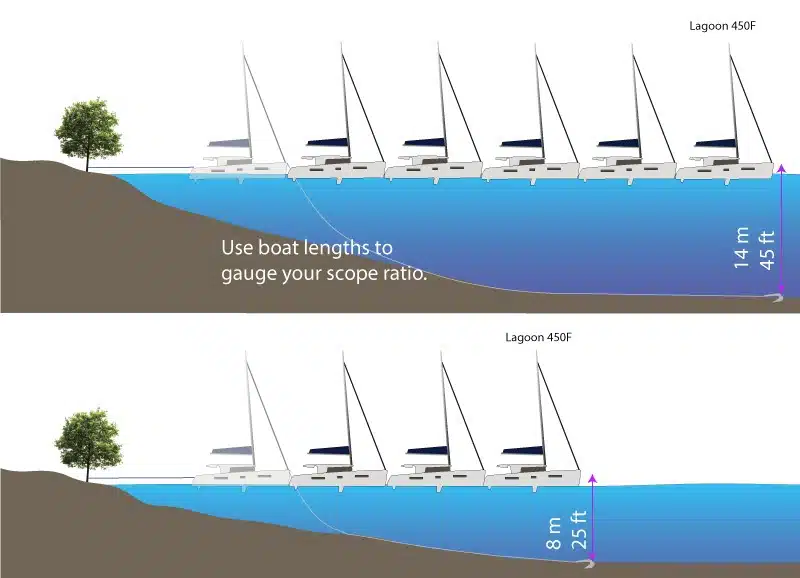
As a useful starting point, the RYA's environmental anchoring guidance suggests around four times the maximum depth when using all chain, or around six times depth for a chain-and-rope combination.
So if you're anchored in five metres of water, 20 metres of chain might represent a reasonable starting point in settled conditions.
But remember what depth actually means.
If your depth sounder reads five metres beneath the keel and your bow roller sits more than a metre above the water, you're not anchoring in five metres.
And if the forecast says the wind is going to increase substantially overnight, we'd rather have extra chain deployed before everyone goes to bed than discover at 2am that the boat has started moving backwards.
The limiting factor in crowded Mediterranean coves is often space.
If every other yacht has 25 metres of chain out and you deploy 60 metres, your swinging circle may become everyone else's problem.
Anchoring well isn't about deploying the maximum amount of chain possible.
It's about deploying enough.
Setting the Anchor Is the Bit People Skip
Dropping the hook is only half the process.
Once the anchor reaches the bottom, allow the boat to move backwards while progressively paying out chain rather than simply dumping the entire pile onto the seabed.
When you've deployed the required amount, gently load the anchor in reverse.
Then increase the engine power.
Exactly how hard you pull depends on the boat and circumstances, but if you're intending to sleep aboard, you want convincing evidence that the anchor will hold considerably more force than it experienced while you were setting it.
Watch something ashore.
Check your chartplotter.
Feel the chain.
If the boat continues moving backwards under steady power, the anchor isn't set.
Retrieve it and try again.
There is no shame in resetting an anchor three times.
There is considerably more embarrassment involved in discovering your first attempt wasn't good enough when you're drifting through the anchorage at midnight.
Sand Is Your Friend
Much of the Mediterranean provides excellent holding in sand.
And because the water is often extremely clear, you can frequently identify the seabed before dropping the anchor.
Sand normally appears pale or turquoise from above. Rock and vegetation look darker.
Finding a good patch of clean sand gives the anchor somewhere to dig in and, in areas containing protected seagrass, can also be environmentally essential.
Mud can provide excellent holding too, although retrieving the anchor may make your foredeck look as though someone has emptied a cement mixer over it.
Rock is a different proposition.
An anchor may initially catch extremely well on rock but can become trapped rather than genuinely buried. In some situations it may also be impossible to recover without diving.
Knowing what is beneath you is therefore just as important as knowing how deep the water is.
Then There Is Posidonia
Anyone cruising Spain, the Balearics or wider Mediterranean should learn to recognise Posidonia oceanica.
It isn't seaweed.
Posidonia is a marine flowering plant that forms large underwater meadows across the Mediterranean. These habitats provide nursery grounds for marine life, stabilise the seabed, improve water quality and store significant amounts of carbon.
They are also extremely vulnerable to anchors.
An anchor dropped into a Posidonia meadow can tear up plants directly, while heavy chain sweeping around the seabed as the yacht swings can damage a much larger area.
The RYA recommends targeting bare sand away from the edges of seagrass beds and considering not only where the anchor lands but also the area across which the chain may sweep.
In some Mediterranean regions, that isn't merely good environmental practice.
It's the law.
The Balearic Posidonia Rules
The Balearic Islands have some of the Mediterranean's most famous Posidonia meadows — and some of its most heavily used anchorages.
Mallorca, Ibiza, Formentera and Menorca therefore take protection particularly seriously.
Under the Balearic Government's Posidonia conservation framework, uncontrolled anchoring over Posidonia is prohibited. The rules are based around Decree 25/2018, which specifically introduced protection for Posidonia oceanica throughout the islands.
In practical terms, if you're anchoring in the Balearics, put the anchor on sand rather than Posidonia.
And remember the chain.
Dropping the anchor perfectly into a sandy patch isn't much use if 30 metres of chain then lies across the surrounding seagrass.
In popular areas you'll also find regulated buoy fields, and using one can remove much of the uncertainty.
Enforcement shouldn't be treated as theoretical. Patrol boats operate around the islands and can instruct vessels to move where anchoring threatens protected seagrass.
For a visiting skipper, the easiest rule is also the safest:
If you aren't certain the anchor and chain are clear of Posidonia, move.
There is nearly always another patch of sand.
Don't Assume the Rules Are Identical Everywhere
This is important.
There isn't one single set of "Mediterranean anchoring rules".
Spain, France, Italy, Greece, Croatia and individual protected areas can impose their own restrictions. Some locations ban anchoring completely in designated zones, others provide mandatory mooring buoys, and some restrict anchoring according to vessel size.
Protected national parks and marine reserves can have additional requirements.
That means the chartplotter isn't necessarily the final authority.
Before cruising into a protected anchorage, check the current local rules and notices rather than relying on what somebody told you three summers ago.
Environmental restrictions around popular Mediterranean cruising grounds are becoming stricter, not looser.
What About Mediterranean Mooring?
Eventually, anyone cruising the Mediterranean will encounter the other great local boating tradition: the Med moor.
Instead of lying alongside a pontoon, boats generally berth stern-to or bows-to, secured at one end to the quay and at the other by an anchor or a laid mooring line.
It allows far more boats to fit along a waterfront and works particularly well in the Mediterranean because tidal ranges are generally small.
The RYA notes that stern-to is the typical arrangement, although going bows-to can make sense where underwater depth near the quay is uncertain because it keeps vulnerable drives and rudders further offshore.
Many modern marinas use lazy lines permanently attached to the seabed rather than requiring boats to deploy their own anchors.
In smaller Greek or Croatian harbours, however, using your own anchor remains common.
That introduces a whole new anchoring challenge.
Your anchor needs to be placed far enough from the quay to provide good holding while avoiding everyone else's ground tackle.
Crossed anchors are one of the great joys of a busy Mediterranean harbour on departure morning.
Using a Stern Line Ashore
Some of the best Mediterranean anchorages are too narrow for conventional swinging.
This is where a stern line ashore becomes useful.
You anchor from the bow, reverse towards the edge of the bay and take one or sometimes two long lines from the stern to suitable shore attachment points.
This keeps the yacht pointing in one direction and allows several boats to occupy a relatively narrow inlet.
It's particularly common in Greece and Croatia.
But approach it carefully.
Never assume tying to a tree or rock is permitted, particularly in protected areas. Be aware of swimmers and tenders crossing your lines, and use long enough lines that you're not positioning the stern dangerously close to rocks.
The person going ashore with the line also needs a safe way of getting there.
Launching someone from the bathing platform holding 50 metres of rope while the boat drifts sideways isn't an anchoring strategy.
Your Anchor Alarm Is Cheap Insurance
Modern phones, chartplotters and navigation apps make it remarkably easy to monitor whether a boat is dragging.
Use them.
Set an anchor alarm based on your expected swinging circle and position.
But don't make the alarm so tight that it wakes you every time the boat moves through 20 degrees with the wind.
Equally, don't set a 200-metre radius because you'd rather not be disturbed.
The point is to alert you before the situation becomes dangerous.
If stronger weather is forecast overnight, take some visual bearings before going to sleep as well.
Electronics are excellent.
A headland doesn't run out of battery.
The Snubber Is One of the Best Upgrades You Can Make
If you anchor on all chain, use a proper snubber.
A length of appropriately sized rope attached between the chain and a strong point on the boat absorbs shock loads and stops the windlass carrying the entire anchoring load.
It also makes life aboard considerably quieter.
Without one, every gust can send a metallic shock through the chain and directly into the bow.
With a decent snubber, the whole system becomes more elastic.
For an overnight Mediterranean cruiser, we'd consider one essential rather than optional.
The Real Skill Is Knowing When to Leave
You can have a large modern anchor, 60 metres of excellent chain and perfect technique.
Sometimes the anchorage still isn't right.
Perhaps the wind has shifted.
Maybe swell has begun wrapping around the headland.
Perhaps ten more yachts have arrived and somebody has anchored directly in your swinging circle.
Leave.
One of the strangest habits in boating is the determination to remain somewhere simply because you've already anchored there.
An anchorage isn't a hotel reservation.
If conditions deteriorate, retrieve the anchor and find somewhere better.
The boat exists specifically to let you move.
The Verdict
Anchoring is one of the simplest things you do on a boat and one of the easiest to do badly.
The fundamentals aren't complicated.
Use good ground tackle. Choose the seabed carefully. Deploy sufficient scope. Set the anchor properly. Monitor the boat afterwards.
In the Mediterranean, add one more rule:
Know what you're anchoring on.
Posidonia meadows are one of the reasons Mediterranean water remains so spectacular, and destroying a patch of them to save five minutes looking for sand is unnecessary as well as potentially illegal.
Learn to identify the seabed, understand the local restrictions and get comfortable resetting the anchor when you're not happy.
Once you trust your ground tackle, an entirely different style of cruising opens up.
You stop planning every night around marinas.
You start looking at the chart for quiet coves instead.
And eventually, waking up at anchor with nothing between the stern and the beach but clear Mediterranean water becomes one of the main reasons you own the boat in the first place.
Cruising the Mediterranean?
Use the Jack & Anchor Marina Directory to research marinas and cruising bases across Spain and Europe, or the Marine Services Directory to find local engineers, chandlers and marine specialists.
If you're still looking for your next cruising boat, browse Boats for Sale or use BoatCheck to investigate a used yacht or motorboat before buying.