
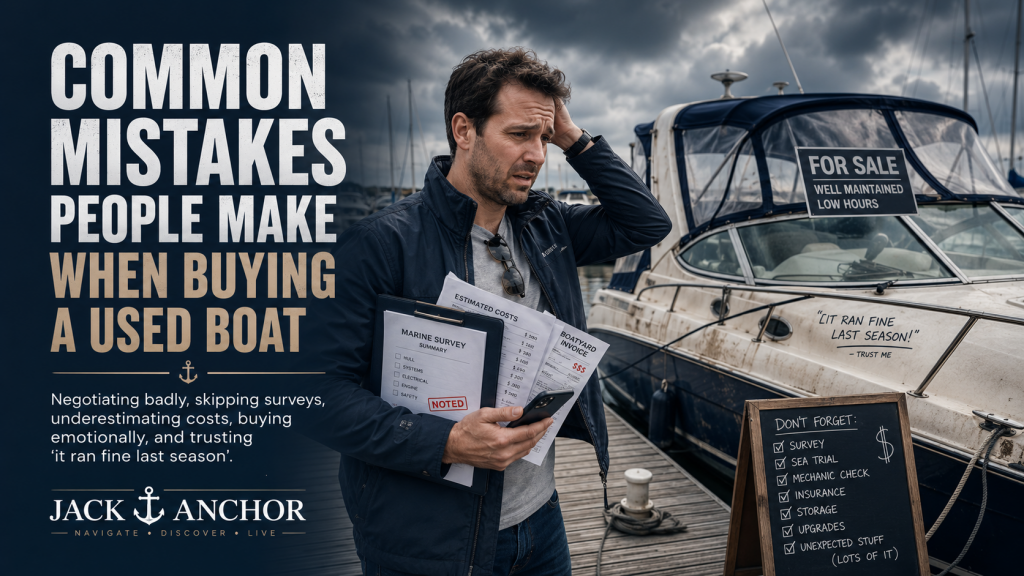
Buying a used boat is exciting, dangerous and very good at making sensible people behave like they have just discovered treasure.
One minute you are calmly browsing used boats for sale. The next, you are standing on a pontoon saying things like “she’s got character” while ignoring the smell of damp, the mystery stain near the galley and the fact the engine has not been started since the previous prime minister.
A good used boat can be one of the best purchases you ever make. It can give you weekends away, family adventures, quiet anchorages, fishing trips, coastal cruising and the slightly smug pleasure of arriving somewhere by water.
A bad used boat can give you invoices, stress, arguments, more invoices and a new relationship with the phrase “while we’re here, we may as well replace that too”.
The difference often comes down to avoiding the common mistakes people make when buying a used boat.
Here are the big ones.
1. Buying emotionally because the boat “feels right”
This is probably the most common mistake of all.
You step aboard, the sun comes out, the cockpit looks perfect, the cushions match, and suddenly you are no longer buying a boat. You are buying a lifestyle, a personality and a better version of yourself who definitely knows how to reverse into a marina berth without panic.
Emotion is part of buying a boat. It should be. Boats are not spreadsheets with engines. But buying a used boat purely because it gives you a warm feeling is how people end up explaining to their partner why the “small project” now needs a new canopy, new batteries, new upholstery and possibly an exorcist.
The trick is to enjoy the excitement but make the decision slowly.
Ask yourself:
Could I still afford this boat if it needs work?
Does it suit how I will actually use it?
Is it the right size for my experience?
Can I berth it locally?
Will my family enjoy it, or will they simply become passengers in my midlife marina admin project?
A boat can look perfect and still be wrong for you. Equally, the right boat may not be the shiniest one online. It may simply be the one that suits your budget, boating plans, confidence level and maintenance tolerance.
2. Skipping the survey to “save money”
Skipping a marine survey when buying a used boat is like buying a house because the front door looked trustworthy.
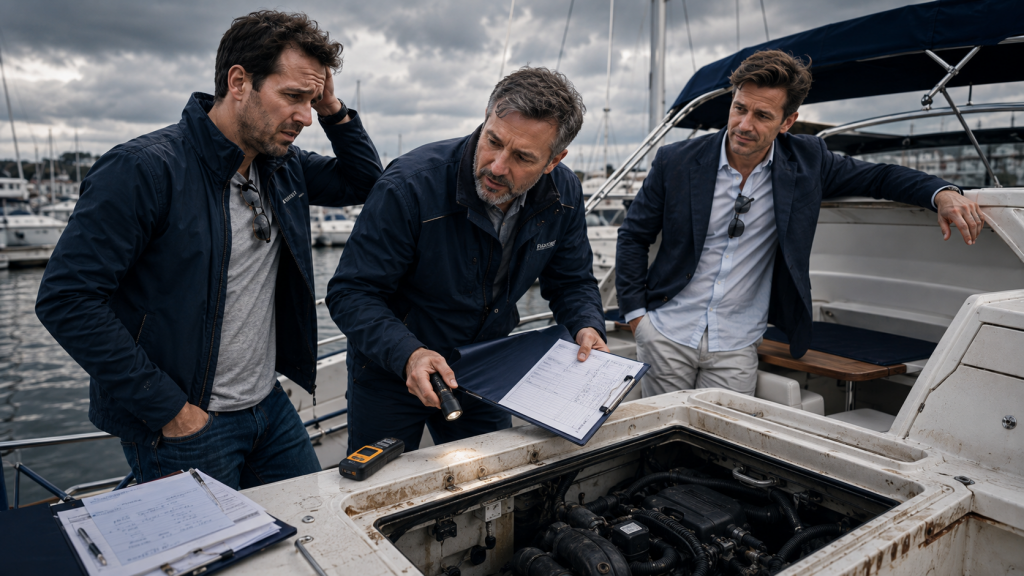
A proper boat survey is not just a tick-box exercise. It is one of the most important parts of buying a used boat, especially if you are new to boating. A survey can identify structural issues, hull problems, damp, osmosis, corrosion, worn fittings, tired systems, unsafe repairs, electrical faults, ageing rigging and other problems that are not obvious during a quick viewing.
It can also help you negotiate. If the survey finds genuine issues, you may be able to ask the seller to reduce the price, carry out repairs, or agree a fair compromise before completion.
Some buyers skip the survey because the boat is “not that expensive”. That can be a false economy. A cheaper used boat can still produce expensive problems. The sea does not offer discounted corrosion because you bought at the lower end of the market.
Others skip it because the seller seems honest. The seller may be honest. They may also be unaware of the problem. Plenty of boat issues hide quietly until someone who knows what they are doing starts tapping, testing and lifting things.
Better approach: use an independent marine surveyor, ideally one with experience in the type of boat you are buying. Treat the survey as protection, not as an annoying extra cost.
3. Trusting “it ran fine last season”
This phrase has caused more trouble than almost any other sentence in boating.
“It ran fine last season” might mean the engine was serviced, used regularly and carefully looked after.
It might also mean it coughed into life once, made a worrying noise, got everyone back to the berth and has not been touched since.
Engines do not become reliable because someone remembers them fondly. When buying a used motorboat, sports cruiser, RIB or sailing yacht with an auxiliary engine, you need evidence. Service history, invoices, engine hours, maintenance records and a proper inspection all matter.
A sea trial is also important where practical. An engine can sound acceptable at idle and behave very differently under load. You want to know how it starts, runs, cools, accelerates, charges, steers and behaves at normal cruising speed.
Be especially careful with boats that have been sitting unused for long periods. Lack of use can be just as damaging as heavy use. Fuel issues, seized parts, perished seals, flat batteries and blocked cooling systems do not care that the seller had good intentions.
Better approach: ask for service records, check engine hours, inspect the engine bay, look for leaks or corrosion, and arrange a sea trial or mechanical inspection where appropriate.
4. Negotiating badly, or not negotiating at all
Some buyers make the mistake of going in too aggressively, waving around a low offer and expecting the seller to thank them for their financial honesty. Others do the opposite and pay the asking price because they feel awkward negotiating.
Neither approach is ideal.
Negotiating on a used boat should be calm, informed and based on evidence. If similar boats are listed for less, say so. If the survey identifies issues, use the report. If the boat needs obvious work, factor it in. If the boat is well presented, fairly priced and in demand, accept that there may not be much room.
The worst negotiation tactic is inventing problems or making vague comments like “I’ve seen cheaper ones”. Sellers hear that constantly. It is more effective to be specific.
For example:
“The survey has identified ageing batteries, worn covers and overdue antifouling. Based on the likely cost of putting those right, I would be comfortable at £X.”
That is much stronger than:
“Best price for cash?”
This is not Facebook Marketplace for a second-hand lawnmower.
Better approach: research comparable boats, understand the boat’s condition, wait for survey findings where possible, and negotiate politely with evidence.
5. Underestimating the real cost of ownership
The purchase price is only the beginning.
This is the bit new boat buyers often underestimate. You do not just buy a boat. You keep a boat. That means ongoing costs.
Typical used boat ownership costs may include:
Berthing or marina fees
Insurance
Engine servicing
Antifouling
Lift-out and launch costs
Winter storage
Fuel
Repairs
Replacement parts
Cleaning and polishing
Safety equipment
Navigation updates
Canopies and covers
Batteries
Anodes
Mooring lines and fenders
Unexpected “how much?” moments
Some of these costs are predictable. Others appear suddenly, often just after you have told someone boating is not as expensive as people think.
The bigger and more complex the boat, the more you should budget. A small day boat with an outboard will usually be far cheaper to run than a large sports cruiser with twin engines, generators, air conditioning, multiple heads and enough electrics to make a marine engineer sigh before opening the hatch.
Better approach: before buying, make a realistic annual running cost estimate. Include berthing, insurance, maintenance, servicing, fuel and a contingency fund. Then add a bit more because boats have excellent comic timing.
6. Forgetting about berthing and storage
Many buyers fall in love with a boat before working out where it will live.
This is a problem because boats are not like bicycles. You cannot simply lean one against the garage wall while you “sort something out”.
Marina berths can be expensive, limited or subject to waiting lists. Some marinas may not have space for your boat’s length or beam. Trailer boats need storage, launching access and a suitable tow vehicle. Larger boats may need winter storage, lift-out facilities and reliable local maintenance support.
Location matters too. If your boat is kept too far away, you may use it far less than expected. A cheaper berth two hours away can become expensive in lost weekends and family enthusiasm.
There is no point buying the perfect boat if getting to it feels like a small expedition.
Better approach: speak to marinas before making an offer. Confirm berth availability, annual costs, access, parking, security, shore power, water, lift-out facilities and any restrictions.
7. Ignoring the boring paperwork
Paperwork is not the glamorous side of buying a used boat, but it matters.
You need to understand what documentation comes with the boat. Depending on the boat, its age, location and history, this may include proof of ownership, builder’s certificate, VAT evidence, registration documents, previous bills of sale, service records, manuals, survey reports, finance clearance and evidence of compliance where relevant.
Do not assume everything is fine because the seller seems confident. Confidence is not documentation.
Missing paperwork can make a boat harder to insure, finance, sell later or move between jurisdictions. It can also create uncertainty over ownership, VAT status or outstanding finance.
This is where using a reputable broker, solicitor or marine professional can be useful, especially for higher-value boats.
Better approach: ask early what documents are available. If anything important is missing, understand the implications before you proceed.
8. Not checking the boat suits your actual boating life
A classic first-time buyer mistake is buying too much boat, too soon.
A larger boat may look more impressive, but it can also be more expensive, harder to handle, harder to berth, more complicated to maintain and more intimidating to use. If every trip feels like launching a small military exercise, you may use the boat less.
Equally, buying too little boat can be frustrating if you quickly outgrow it. A tiny day boat may not suit family weekends. A fishing-focused layout may not work for relaxed cruising. A beautiful sailing yacht may not be ideal if your family mainly wants short trips, easy swimming and somewhere to make coffee.
Think honestly about your use case.
Will you use it for day trips?
Fishing?
Water sports?
Family weekends?
Coastal cruising?
Overnight stays?
Entertaining friends?
Exploring rivers and estuaries?
Learning slowly without terrifying yourself?
The right used boat is not always the one that looks best in photos. It is the one you will actually use.
Better approach: choose a boat for your real life, not your imaginary boating montage.
9. Being dazzled by shiny upgrades
New electronics, fresh cushions, smart lighting and a glossy cockpit can make a used boat look fantastic.
But do not let cosmetic upgrades distract you from the expensive fundamentals.
A new chartplotter is nice. A neglected engine is not. Fresh upholstery is lovely. A damp cabin is less lovely. A polished hull looks good. A poor survey does not.
When viewing a used boat, separate presentation from condition. A well-presented boat may be well cared for, but you still need to inspect properly. A scruffy boat may be mechanically sound, but you need to know what it will cost to bring it up to standard.
The big-ticket items matter most: hull, engine, stern gear, rigging, electrics, plumbing, safety systems, deck fittings and evidence of maintenance.
Better approach: enjoy the nice extras, but do not pay a premium for accessories while ignoring the basics.
10. Not getting insurance quotes early
Boat insurance is easy to forget until the last minute.
That can cause problems. Insurers may ask about the boat’s value, age, survey, mooring, cruising area, your experience and security arrangements. For older boats, a recent survey may be required. For certain types of boat, cover may be more limited or expensive than expected.
You do not want to complete the purchase and then discover insurance is awkward, expensive or dependent on repair work being carried out first.
Insurance can also affect where you can keep the boat, how far you can travel, whether you are covered during delivery and what happens during winter storage.
Better approach: get quotes before completion. Be clear about where the boat will be kept, how it will be used and whether any survey recommendations affect cover.
11. Assuming the seller’s version of value is the market value
Every seller believes their boat is special.
Sometimes they are right. Sometimes “well maintained” means there is a folder of invoices, recent servicing, fresh antifoul and careful ownership.
Sometimes it means they once washed it before a bank holiday.
Used boat prices can vary widely depending on condition, age, engine, specification, location, history and demand. The asking price is not always the market price. It is the seller’s opening opinion.
Compare similar boats carefully. Look at year, model, engine type, engine hours, equipment, condition, survey findings and location. Be careful with unusually cheap boats too. A bargain can be a genuine opportunity, but it can also be a floating invoice with cushions.
Better approach: compare like with like and focus on total value, not just asking price.
12. Forgetting that delivery and transport can be complicated
Buying the boat is one thing. Getting it where you need it is another.
If the boat is not already near your preferred marina, you may need to arrange delivery by sea, road transport, lift-out, launch, temporary berthing or professional skippering. Costs can add up quickly, especially for larger boats or longer distances.
You also need to think about insurance during transport, weather windows, documentation, fuel, crew and whether the boat is actually ready to make the journey.
The phrase “you can just sail it back” is doing a lot of work there.
Better approach: price transport or delivery before committing. If the boat needs work before moving, factor that into your budget and timeline.
Final thoughts: buy with your head, then enjoy it with your heart
Buying a used boat should be exciting. It should feel like the start of something brilliant. But the best purchases happen when the excitement is backed up by proper checks, realistic budgeting and a calm look at what the boat really needs.
Do not skip the survey.
Do not trust vague claims without evidence.
Do not underestimate marina fees and maintenance.
Do not negotiate from guesswork.
Do not buy the wrong boat for your actual life.
And be very careful with anything described as “ran fine last season”.
At Jack & Anchor, we help buyers find used boats for sale and connect with the services that make the buying process easier, from surveys and insurance to finance, transport and marine maintenance.
Because the aim is simple: buy the right boat, avoid the obvious mistakes and get on the water without accidentally funding a floating restoration project.